
Volume of a Hemisphere
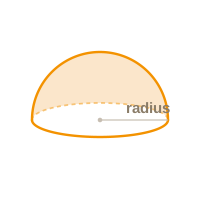
Volume calculator for a hemisphere
Description, how many faces, edges and vertices are there in a hemisphere
A hemisphere is half of a sphere: it is obtained by cutting a sphere with a plane that passes through its center. It has one curved face (half a spherical surface) and one flat circular face.
Examples of a hemisphere
You can find many hemisphere-shaped objects: a dome, half a lemon or half an orange, an igloo, a bowl and some parachutes. Can you think of any others? Leave us a comment in the box at the bottom of the page.
Formula for the volume of a hemisphere
To calculate the volume of a hemisphere you only need the radius. Since it is half of a sphere, its volume is 2/3 of π times the radius cubed. You can also use the online tool to calculate the volume automatically.
Surface area of a hemisphere
The total area of a hemisphere adds the curved surface (2πr²) and the flat circular base (πr²), which gives 3πr².
Worked example: volume of a hemisphere
Hemisphere with a radius of 6 cm:
V = (2 × π × radius³) ÷ 3 = (2 × 3.1416 × 6³) ÷ 3
V = (2 × 3.1416 × 216) ÷ 3 = 1,357.2 ÷ 3 ≈ 452.4 cm³
Frequently asked questions about the volume of a hemisphere
What is the formula for the volume of a hemisphere?
The formula is V = 2πr³ / 3, where r is the radius and π ≈ 3.1416. It is exactly half the volume of a sphere with the same radius.
How do you calculate the volume of a hemisphere step by step?
Cube the radius, multiply it by 2 and by π, and divide by 3. For example, a hemisphere with a radius of 6 cm has a volume of ≈ 452.4 cm³.
What is the surface area of a hemisphere?
It is calculated with A = 3πr²: the curved surface (2πr²) plus the circular base (πr²). For a radius of 6 cm, A ≈ 339.3 cm².
How many faces, edges and vertices does a hemisphere have?
It has 2 faces (one curved and one flat circular), 1 curved edge (the rim of the circle) and no vertices.
What is the difference between a hemisphere and a sphere?
A hemisphere is exactly half of a sphere. That is why its volume is half (2πr³/3 versus 4πr³/3) and, unlike the sphere, it has a flat face.
Volume of other shapes
Volume of different geometric shapes: