
Volume of an Oblique Cylinder
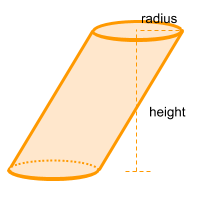
Volume calculator for an oblique cylinder
Description, how many faces, edges and vertices are there in an oblique cylinder
The oblique cylinder, is a cylinder where the base and its opposite base are not aligned. It has 3faces just like a regular cylinder, 2 faces that form the base and the opposite base and one face that forms a curved side. 2 curved edges and no vertices.
If the base and the opposite base are aligned, we are in the presence of a regular cylinder.
Examples of an oblique cylinder
We can find many objects that look like an oblique cylinder, examples of oblique cylinder shaped objects are: the famous Tower of Pisa in Italy or a stack of poker chips which are tilt to one side. Can you think of any other examples? leave a comment in the comment section at the bottom of the page.
Formula for the volume of an oblique cylinder
To calculate the volume of an oblique cylinder is very simple, we must multiply π (Pi = ~ 3.14) by the radius to the power of two and then multiply by the height. In this case the height forms a 90 degree angle from the opposite base to the position of the base, but outside of it.
You can also use the online calculator to get the oblique cylinder volume automatically.
The formula for the volume of a regular cylinder or an oblique cylinder is the same, if we imagine a stack of poker chips (forming a cylinder), even when we tilt the chips to one side (forming an oblique cylinder) the volume remains the same.
Surface area of an oblique cylinder
The two bases of an oblique cylinder are still circles, but its slanted lateral surface has no simple elementary formula. The volume is calculated just like a right cylinder.
Worked example: volume of an oblique cylinder
Oblique cylinder with a radius of 3 cm and a height of 10 cm (height = vertical distance between the bases):
V = π × radius² × height = 3.1416 × 9 × 10 ≈ 282.7 cm³
Frequently asked questions about the volume of an oblique cylinder
What is the formula for the volume of an oblique cylinder?
It is the same as a right cylinder: V = π·r²·height, using the perpendicular height between the two bases.
How do you calculate the volume of an oblique cylinder step by step?
Square the radius, multiply by π and by the vertical height. With radius 3 cm and height 10 cm, the volume is ≈ 282.7 cm³.
Why does an oblique cylinder have the same volume as a right one?
Because of Cavalieri's principle: having the same height and cross-sections of equal area at every level, the volume does not change even though the cylinder is tilted.
How many faces, edges and vertices does an oblique cylinder have?
Same as a right cylinder: 3 faces (two circular bases and the lateral one), 2 curved edges and no vertices.
What is the difference between an oblique cylinder and a right one?
In a right cylinder the bases are vertically aligned; in an oblique cylinder they are offset and the axis is tilted. Both share the same volume.
Volume of other shapes
Volume of different geometric shapes: