
Volume of a Capsule
Volume calculator for a capsule
Description, how many faces, edges and vertices are there in a capsule
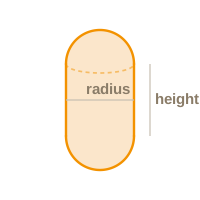
A capsule (or stadium of revolution) is a cylinder capped by two hemispheres, one at each end. It is a smooth surface, with no edges or vertices, and is defined by the radius r and the height of the central cylinder h.
Examples of a capsule
You can find many capsule-shaped objects: a pill or medicine capsule, a gas or propane tank, a compressed-air vessel and some elongated balloons. Can you think of any others? Leave us a comment in the box at the bottom of the page.
Formula for the volume of a capsule
To calculate the volume of a capsule you add the volume of the central cylinder (πr²·height) and that of a full sphere formed by the two hemispheres (4/3·πr³). You can also use the online tool to calculate the volume automatically.
Surface area of a capsule
The surface area adds the cylindrical part (2πr·height) and the two hemispheres, which together form a full sphere (4πr²), giving 2πr(height + 2r).
Worked example: volume of a capsule
Capsule with a radius of 3 cm and a cylinder height of 10 cm:
V = π × radius² × (height + 4×radius ÷ 3)
V = π × 9 × (10 + 4) = π × 9 × 14 ≈ 395.8 cm³
Frequently asked questions about the volume of a capsule
What is the formula for the volume of a capsule?
The formula is V = πr²·(h + 4r/3), that is the central cylinder (πr²h) plus a full sphere (4/3·πr³) formed by the two end hemispheres.
How do you calculate the volume of a capsule step by step?
Work out the cylinder (πr²·height) and add the sphere of the two hemispheres (4/3·πr³). For example, with a radius of 3 cm and a height of 10 cm the volume is ≈ 395.8 cm³.
What is the surface area of a capsule?
It is calculated with A = 2πr·(height + 2r): the cylindrical part plus the two hemispheres. For a radius of 3 cm and a height of 10 cm, A ≈ 301.6 cm².
How many faces, edges and vertices does a capsule have?
A capsule is a single continuous smooth surface: it has one curved face and no edges or vertices.
What is a capsule in geometry?
It is the shape that results from a cylinder with a hemisphere at each end. It is seen in pills and medicine capsules, gas tanks and compressed-air vessels.
Volume of other shapes
Volume of different geometric shapes: