
Volume of a Rhombic Prism
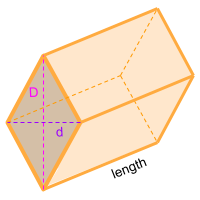
Volume calculator for a rhombic prism
Description, how many faces, edges and vertices are there in a rhombic prism
The rhombic prism, is a shape that if a cross section is made in any part of its length, always maintains the shape of a rhombus. It has 6 faces, 2 of which are rhombus and form the bases at the ends of the solid, these bases are parallel, it has 12 edges and 8 vertices.
Formula for the volume of a rhombic prism
To calculate the volume of a rhombic prism you can use the formula to calculate the volume of all prisms. where the area of one of the bases is multiplied by the length of the prism. In this case, the base of the rhombic prism is a rhombus, therefore the area of the rhombus needs to be a known value. To get the area of a rhombus, the long and short diagonal need to be multiplied and then divided by 2, finally multiply the result by the length of the prism. You can also use the online calculator to calculate the volume of the diamond prism automatically.
Formula explanation:
The formula to calculate the volume of prism is always the same:
In this case, the area of the base of the rhombic prism is a rhombus:
Replacing the calculated area in the formula for volume of prisms we get the formula shown above.
Surface area of a rhombic prism
The surface adds 2 rhombus bases plus 4 lateral rectangles. The side of the rhombus is √((D/2)² + (d/2)²), with D and d being the diagonals.
Worked example: volume of a rhombic prism
Prism with a rhombic base of longer diagonal 8 cm, shorter diagonal 6 cm and a length of 10 cm:
V = (D × d ÷ 2) × length = (8 × 6 ÷ 2) × 10 = 24 × 10 = 240 cm³
Rhombus side = √(4² + 3²) = 5 cm; surface A = 8×6 + 4 × 10 × 5 = 48 + 200 = 248 cm².
Frequently asked questions about the volume of a rhombic prism
What is the formula for the volume of a rhombic prism?
The formula is V = (D·d / 2)·length, where D and d are the longer and shorter diagonals of the rhombus base and the length is the depth of the prism.
How do you calculate the volume of a rhombic prism step by step?
Work out the area of the rhombus (D × d ÷ 2) and multiply it by the length. For example, with D = 8 cm, d = 6 cm and length 10 cm, the volume is 240 cm³.
What is the surface area of a rhombic prism?
It is calculated with A = D·d + 4·length·√((D/2)² + (d/2)²): two rhombuses plus four lateral rectangles.
How many faces, edges and vertices does a rhombic prism have?
It has 6 faces (2 rhombuses and 4 rectangles), 12 edges and 8 vertices.
What is a rhombus?
A rhombus is a quadrilateral with four equal sides and perpendicular diagonals. Its area is calculated by multiplying the diagonals and dividing by 2.
Volume of other shapes
Volume of different geometric shapes: